








Sponsored Link: Legally "Eavesdrop" on this Private Gathering of Top Technology CEOs

Automakers & PHEVs: Between “Barack” and a Hard Place

by David Fessler, Advisory Panelist
Friday, March 20, 2009: Issue #960

During the last few years of the Bush administration, the EPA was directed to ignore California’s pleas to grant it a waiver of the Clean Air Act.

Why? The grant would effectively have permitted California to enforce stricter emission rules its legislature had enacted a number of years before.

The EPA dragged its feet because as many as 16 other states were considering legislation modeled after California’s – with one notable difference: emission rules even more stringent than California’s.

The automakers lobbied Bush administration officials to oppose California’s request. And it’s not hard to understand why: They’re struggling just to stay in business.

But now, automakers are between Barack and a hard place, as the President told the EPA to “reconsider” its Bush-era denial. If it does, car manufacturers could find themselves having to make cars that get 43 mpg by 2016. It’s why PHEVs have generated so much interest lately.

Not that that’s a bad thing – but it’s far more aggressive than the current goal of 35 mpg by 2020. The problem is that the new requirement would nearly double today’s fleet-wide average of 25 mpg.

Automakers Scramble To Get Into Plug-In Electric Vehicles

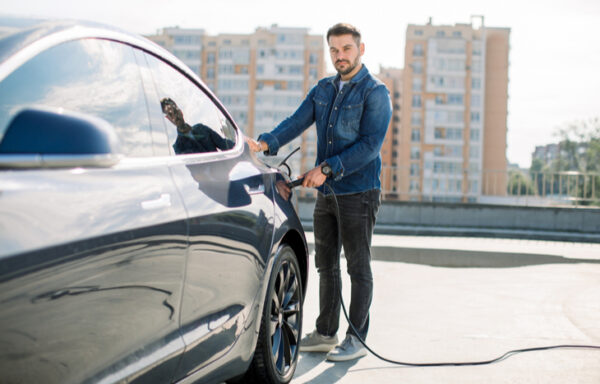
All this has had the automaker’s scrambling to get into the Plug-In Electric Vehicle (PHEV) business. Most already have an active PHEV development program underway, with GM being the closest to production with its Chevy Volt.

Unfortunately, GM is also teetering on the edge of bankruptcy.

Necessity is the mother of invention, and we’re seeing that in spades with PHEV development. One of the more intriguing schemes is the “Vehicle-to-Grid” (V2G) concept, and it’s been strongly endorsed by the head of the Federal Energy Regulatory Commission (FERC).

It works like this:

  • When your V2G car is plugged in to recharge its batteries, the utility regulates the rate at which it is charged.
  • More importantly, it can reverse the flow and use the V2G’s battery pack as a power source during peak use periods on the grid.
  • Similar to the way cloud computing works – where many PCs are combined to create a huge supercomputer – all the V2G vehicles taken as a whole would equate to a giant, nationwide power storage battery.

In return, the vehicle’s owner would receive a credit towards his or her electric bill. It’s been estimated that – utilizing this concept – the entire premium cost for owning a V2G vehicle could be recouped in as little as three years.

The benefits go way beyond recouping the added expense of owning an electric car, however.

  • By reducing our demand for oil and gas, it would make the process of weaning ourselves off of fossil fuels much less painful.
  • Greenhouse gases would significantly decrease, an impact that would be most notable in densely populated urban areas.
  • The additional revenue that the power companies would reap from PHEV charging could finance the additional solar, geothermal or wind power installations necessary to provide the additional charging power.
  • It also solves one of the biggest problems with solar and wind power: That they can’t be used as baseload supplies.
  • This giant nationwide, distributed storage system would allow utilities everywhere to store power from solar and wind sources and redistribute it whenever it’s needed.

For the moment, neither GM nor Toyota – the two leading PHEV contenders – have announced any plans to produce this type of vehicle.

Clearly what’s needed is legislative regulation or an incentive (or both) from the FERC that will coax the utility companies into embracing the V2G concept. This will create the need for the vehicles, and the incentive for car companies to build them.

The Fly In the Ointment – Improving Battery Technology

The only fly in the ointment – and regular readers have heard me say this before – is an improvement in battery technology.

Right now, the most promising technology that seems like it can provide the power densities required for the 100 to 200 mile target commuting range is Lithium-Ion.

And those few companies in the lithium battery business are destined to be the big winners, as the technological challenges are met. So who’s in the battery business?

EnerSys (Nasdaq: ENS) is one of the largest manufacturers, marketers and distributors of industrial batteries. From submarines to spaceships – and everything in between – EnerSys has a battery technology to fit the application. It also makes the charging and power equipment as well.

Last fall, the company launched its EcoSafe line of batteries designed for renewable energy storage applications. Targeted towards the wind and solar energy generation markets, this product line should see significant growth under President Obama’s EPA initiatives.

Of more interest to us, EnerSys is working with a number of niche players to develop a lithium-ion line of batteries specifically targeted to the PHEV transportation market.

Where Will All the Lithium Come From?

The short answer is Bolivia and Chile, and Sociedad de Chile (NYSE: SQM) – based in Santiago, Chile – is a world leader in the production of lithium carbonate and a number of other specialty chemicals.

Right now, the world’s demand for lithium is growing at roughly 7% annually. SQM leads the world in lithium production, too, with over 30% market share.

Lithium is used in greases, glass and portable power tool batteries, but its biggest future growth prospects are large, lithium-ion batteries for hybrid electric vehicles. New HEV battery demand is expected to ramp up sharply in the latter half of 2009, and even more in 2010.

And SQM is getting ready to meet this increasing demand: Its three-year capital expenditures of $1 billion means an across-the-board capacity increase of 25% to 30% for all of its products by the end of 2010.

Changing 100 Year-Old Perceptions

There’s an old rub that goes something like this: “Science only progresses with the death of each scientist.” The idea is that sometimes it takes the passing of a generation in order for fresh ideas and discoveries to rise to the top of the heap.

Let’s hope – at least in this case – it doesn’t take that long for PHEVs. We don’t have that much time to waste.

Next week, I’ll be speaking at the 2009 Investment U Conference at the beautiful Vinoy Resort in St. Petersburg, Florida. Our regular format will take a week off and instead you’ll be getting daily reports from Scott Brown. I look forward to seeing many of you there.

Good investing,

David Fessler

Today’s Investment U Crib Sheet

Recently we’ve been looking at a number of options and alternatives in the “green” energy sector. And new auto technologies are on the forefront of “hot topics” in this field. The debate over cost effectiveness and environmental impact has been clashing with the scientific hurdles and limits of our current technologies.

In fact, our discussion boards over Plug-in Hybrid Electric Vehicles: The Only Roadblock to PHEVs and the follow up article Is General Motors the Buy of the Decade? PHEVs Part Two ranged from supporting, to disgust over a number of the current options and their potential.

It’s a decision that you’ll have to make for yourself. But regardless of which side you fall on, we all can agree that it’s an area we need to keep an eye on. Whatever technology and solution that emerges will have the potential to change the way we live around the world.

With new solutions and technologies, many of the initial investors are rewarded handsomely – Think Microsoft, Google and Wal-Mart. Ultimately, we don’t have a crystal ball to know exactly what will happen, and that’s why we pay attention to all of the alternatives.

But just because we keep an eye towards the future, doesn’t mean that we are ignoring the profitable energy technologies currently creating vast sums of wealth. In fact Dave Fessler just released some of his latest findings on the “buried treasure” of today’s energy.

Related Investment U Articles:

Sign Up now and receive this Free report:

Collect 122% in the Next 12 Months From Gold's Surge.


Could you use an extra $600 - or more - each month?

If so, you’ll want to check out the details of an overlooked government-backed program in THIS REPORT.

It shows you why the government is set to distribute $457 million to a small group of recipients, how to get your name on the list and the exact deadline you must meet in order to qualify.

Share Investment U:
  • email
  • Print
  • Digg
  • Sphinn
  • del.icio.us
  • Facebook
  • Google Bookmarks
  • Propeller
  • StumbleUpon
  • Technorati
  • Yahoo! Buzz
  • Reddit
  • NewsVine
  • SphereIt
  • Twitter

18 Responses to “Automakers & PHEVs: Between “Barack” and a Hard Place”

  1. mythoughts Says:
    March 20th, 2009 at 10:08 am

    Good article but EV users tied to the grid would see their battery life quickly consumed if the utilities are able to tap into them for backup. The compensation utilities offer would hardly be enough to cover the cost of battery replacement.

    Reply

  2. Roger Charlesworth Says:
    March 20th, 2009 at 10:11 am

    You can FORGET big clumsy battery packs and very finite limits to range. The future of automobiles is in cracking water and burning the hydrogen. Tata of India have already produced this technology. When does the West take note?

    Reply

  3. duke Says:
    March 20th, 2009 at 10:48 am

    Our primary vehicle already gets over 40 MPG! And for over 3 years so far.

    A Prius of course!

    We traded nothing as the prior vehicle had over 150,000 miles and was almost sixteen years old. It was donated to the school system for training future mechanics. Donated might get a tax credit, but we couldn’t make the threshold over the standard deduction.

    Now the dealer wants to sell us a new one! This one is just broken in and we are not interested.

    We also use shoe leather for short trips to grocery, bikes for longer distances. Local bus service is free for retired folks like us too.

    Trips are planned by making several stops on shopping destination. The fewer miles, the less spent of fuel. It takes a bit of planing, but it does have the advantage of reducing number of start, and in winter the car is already warmed up where fuel use is reduced.

    Reply

  4. Ron Says:
    March 20th, 2009 at 11:23 am

    I think the technology which is going to promote the electric car is the super capacitor type battery system still under development. They have the ability to store more charge much more quickly and have it available as power, in a smaller lighter package,both qualities which are being actively sought in the electric car development process.

    Reply

  5. Richard Says:
    March 20th, 2009 at 11:44 am

    We are going to wean ourselelves from the clutches of the oil producing countries and refiners, to become hostages to the countries that are the source of lithium. Out of the frying pan into the fire?

    Reply

  6. Richard Nagel Says:
    March 20th, 2009 at 12:07 pm

    Don’t kid yourself. The next improvement in cars is the new Diesel technology. 40 plus miles per gal. Clean burning, quiet, good power, no smell. Most of the car makers have the engines, most are sold in all the rest of the world. More than 50% of the new cars sold in western Europe are Diesels.
    The Chevrolet Volt, My insiders tell me: too expensive [$40,000]and the current battery is worth $10,000. Even GM insiders say that the battery can’t cost more than $1000. This will take more time, if ever.
    Richard.

    Reply

  7. Mark Says:
    March 20th, 2009 at 1:25 pm

    This is the first post that I have made in the years that I have been diligently reading your newsletters. As quoted below, David Fessler said that we needed more government intervention:

    “Clearly what’s needed is legislative regulation or an incentive (or both) from the FERC that will coax the utility companies into embracing the V2G concept. This will create the need for the vehicles, and the incentive for car companies to build them.”

    Geeezzzz!!!! I have had enough of government regulations!!! NO MORE!!!! Living proof is the idea that the GREEN LIBS came up with regarding corn and alchohol. It worked real well didn’t it? NOT!!!!

    Let’s take this country back from dumb and stupid LIBS and let FREE ENTERPRISE work. Please allow my family and I to be FREE again from this BS!!!

    Reply

    Monty Reply:

    While I agree with your post, I would recommend in the future using a bit more logic, and a lot less emotionalism to sell your idea. When you highlight and capitalize such words as GREEN LIBS, you do nothing to change their minds, or anyone else who doesn’t already agree with you.

    Like Billy Graham preaching to the choir, I’m already saved. If you want to save the congregation, you have to convince the sinners. And calling them names will only get them to call you names in return.

    Reply

  8. Levi Says:
    March 20th, 2009 at 1:35 pm

    Hybrid vehicles will only be a short term “fix”, with limited marketability. Many of the bigger car makers are not even going that route, and are looking to hydrogen based power technologies. In the mean time, they will produce highly efficient gas and diesel vehicles, which we are already seeing come to market in 2010 and beyond. Within 5 years, the market will be flush with vehicles capable of well over 50 mpg, without an electric drive component to get them there.

    Reply

  9. THOMAS VARKONYI Says:
    March 20th, 2009 at 2:36 pm

    My guess is whoever thought up this crazy idea of putting charging car batteries on the grid has no clue about how electricity works. The charging circuit has a diode that prevents discharging the battery through the charging circuit, much like the flap valve in waterlines, so the utility can’t reverse the flow, and why would you ever want them to? You need your battery fully charged ASAP so you can use your car again and get the max mileage from the limited battery capacity.
    This sounds like another scam the environmental zealots want to put over on the public, like the man made global warming scam. We are overdue for the next ice age and that is just fine with me. I will take global warming and rising sea levels anytime over a global ice age. Do you want to move to the Sahara desert to survive?

    Reply

  10. William Losch Says:
    March 20th, 2009 at 2:53 pm

    Why is The Oxford Club getting on the bandwagon in supporting more fascism for the USA? If anything,the US Federal Government should get COMPLETELY out of the US economy, and let the free market get us out of this whole GOVERNMENT CAUSED mess!

    Reply

    Constance Blackwell Reply:

    I must say that is a level of response I would think would be weeded out here. Fascism is obviously completely different – it is so very upsetting to read a comment like that. There are other ways to object to government initiatives that to throw around a word you don’t understand.
    The government has been behind primary and secondary research in the US for decades – the reason the IT, chemical and Airplane industries have been so strong is that the government has given money for research – and bought planes
    Constance Blackwell

    Reply

  11. fred preston Says:
    March 20th, 2009 at 4:25 pm

    First off my car does 50 miles per US gallon.
    It is a small petrol car with direct injection technology. You can buy plenty of larger cars with similar mileage figures that are turbo diesels in Europe.

    So there’s no need for mad electric vehicle ideas which are completetly impractical.

    As for using the vehicles as battery banks for renewables. Are you really going to plug your car in overnight for a recharge and then find that, surprise surprise, there was no sun and the grid system has drained your battery and you can’t get to work. That’s just a ludicrous idea.

    The truth is battery technology is nowhere near electric vehicle requirements and lithium ion still has to get over safety issues.

    Turbo-diesels are the short & intermediate term solution, Ford et al already have the 40-50mpg technology dependant on size and Exxon are investing in expanding US diesel refining capacity – they know it’s the only way to go.

    Forget the dreams and wake up to reality.

    Reply

  12. John Evans Jr. Says:
    March 20th, 2009 at 9:35 pm

    Batteries age and go bad. What are the greens going to do with all the toxic mess from used up batteries? Who ever thought this type of vehicle could be used on a scale to replace the combustion engine has not done their homework.

    Reply

  13. John Taylor Says:
    March 21st, 2009 at 8:49 am

    As always these ideas look great on the surface, and indeed this would work except for a few problems. Working as a supplier of equipment for aluminum-lithium metal (not hydride as in computer batteries) we were supposed to build 20 or 30 plants around the world each with 4 to 7 production bays. Guess what? Lithiunm metal ignites when exposed to moisture. The fire can only be put out by smothering with copper powder. Attempt to extinguish with water causes explosion.
    Also, enough lithium was not even available to run one bay. The Kerr McGee, Quebec Hydro venture closed up after huge expenditures and inability to get some of the complex equipment to work (not ours).
    Hopefully someone can do better ? Best of luck.

    Reply

  14. Gerald Gromnisky Says:
    March 21st, 2009 at 12:06 pm

    excellent article

    Thank-you

    Reply

  15. Dogbiscuit Says:
    March 22nd, 2009 at 8:40 pm

    The laws of thermodynamics tell us that the efficiency of the the internal combustion engine relates directly to the “COMPRESSION RATIO” and we know that it is possible in certain cases for the CR for diesel to be twice that of the average auto engine.

    Reply

  16. yaga Says:
    April 7th, 2009 at 5:51 am

    If science and technology can put a man to the moon and bring him back to earth that long ago why can’t science and technology develope a battery that can recharge itself automatically and asap, with longer mileage range. mybe we need the rocket scientist on this project, or maybe it all boils down to the money, Just think about the money the oil companies and the car manufactures would loose if they would develope an extremely highly efficient battery pack. Think about why they have not found a cure for certain diseases as yet hhhmmmmm. Get the picture!!!

    Reply

Comments

**By submitting your comment you agree to adhere to our Comment Policy and Privacy Policy.

Check out our selection of daily Investment Research:

IU Blackboard IU Archives


We Respect Your Privacy


What is Investment U?

Since 1999, Investment U has provided impartial, no-nonsense investment advice on how to build long-lasting wealth.


Recent Articles


Search Investment U


Platinum Services

Oxford Club
The Oxford Club
is an exclusive, global network of investors, who collectively participate in the pursuit of prosperity and wealth. The Club is renowned for its market-beating, tried-and-true investment principles.

White Cap The White Cap Report exclusively identifies companies, White Caps, which - by being among the earliest to gain traction - have secured dominant positions within untapped, billion-dollar markets.

XPR With an elite trading team at the helm, the Xcelerated Profits Report shows any investor how to "invest like a pro," using high-level, yet easy-to-execute strategies that "xcelerate" profits while minimizing risk.


What Readers Are Saying...

"Always enjoy what you have to say, and learn something new (and useful) almost every time. Thanks again for your outstanding work." Jeff K.

"I just want to say a quick thank you to Alexander Green for not only his sage advise, but his reassuring words of encouragement that we all need right now." Bryan W.