|
Is the U.S. Economy in Crisis?
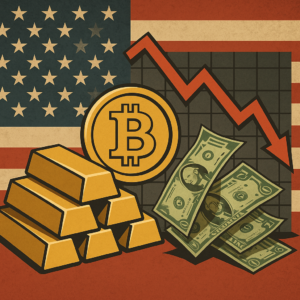
Investment U E-Letter: Issue # 521 Is the U.S. Economy in Crisis? Seven Trends Spell Out an Economic Medley of Woes Last week, I gave a lecture at Columbia University on Ben Bernanke: Can the Fed Survive the Coming Monetary Crisis?” The basis of my remarks is a warning issued by none other than Paul Volker, former Fed chairman, who wrote the following statement a year ago: The U.S. is skating on increasingly thin ice. There are disturbing trends: huge imbalances, disequilibria, risks - call them what you will. Altogether the circumstances seem to me as dangerous and intractable as any I can remember, and I can remember quite a lot. One might expect to hear such a statement from a hardcore gold bug, but from a former Fed chairman? Volker, in my judgment, is the best leader of the Federal Reserve we have ever had. His job of stopping inflation in the early 1980s was much tougher than any of the crises Greenspan faced. What would cause Volker to issue a jeremiad? The fact is, we do face some powerful negative forces down the road that could lead to a dollar panic, a stock market crash, or a banking crisis. And here is what’s driving a possible U.S. economy crisis scenario… A U.S. Economic Medley Of Woes 1. An overreacting Fed, switching from “easy money” to “tight money.” The Fed has been a major source of instability in the financial system. For example, Greenspan was chairman for 19 years, and switched policies seven times! The Fed often overshot its target on both ends - raising interest rates too high in 1989, 1994, and now, and pushing them too low in 1992 and 2003. 2. Inflation and structural imbalances. The Fed’s “easy money” policy caused in part the “irrational exuberance” of the tech stock-market bubble in the late 1990s and the real estate bubble in this decade. When the bubble bursts, as it inevitably must, the effects aren’t pretty. 3. Poor consumer/investor finances. Our government policies promote overspending and undersaving on a massive scale. The saving rate has turned negative, and household debt as a percentage of personal income is at a dangerous level. (See chart below.) 4. A vulnerable financial/banking system. We live in a global laissez faire financial system that is highly leveraged with debt financing, derivatives and fractional reserve banking. Hedge funds are not really “hedged,” but highly speculative, and another collapse along the lines of Long Term Capital Management could be disastrous. (Long Term Capital required a bailout of $4 billion in 1997-98.) 5. Trade deficits and out-of-balance capital flows. The trade deficit is at record levels. To make up this imbalance, foreigners must invest $2 billion a day in the U.S. 6. Overburdened federal debt levels, unfunded liabilities and rising interest rates. The Senate just raised the national debt ceiling to $9 trillion, representing 70% of GDP. Interest expense is now the third-largest category of the federal budget, only exceeded by defense spending and domestic welfare expenditures. Imagine the impact as interest rates start climbing again It’s easy to get carried away with potential disaster scenarios. I am by nature an optimist. You should not ignore the fact that the stock market is currently at a four-year high! We must not ignore the good news out there: record corporate profits, stable long-term interest rates, low taxes on investments, etc. The single indicator I use to monitor global instability is the price of gold. It is the numeraire of global economics. Right now, the price of gold is around $550 an ounce. This is substantially above its lows of 2001, when it was under $300 an ounce. But it’s still substantially below its all-time high of $850 in 1980, when inflation was a double digit. If the price of gold keeps rising, and spikes upward, we’re in trouble. If it stays down, we are still on the road to prosperity. Today’s IU Crib Sheet
Good investing,
|